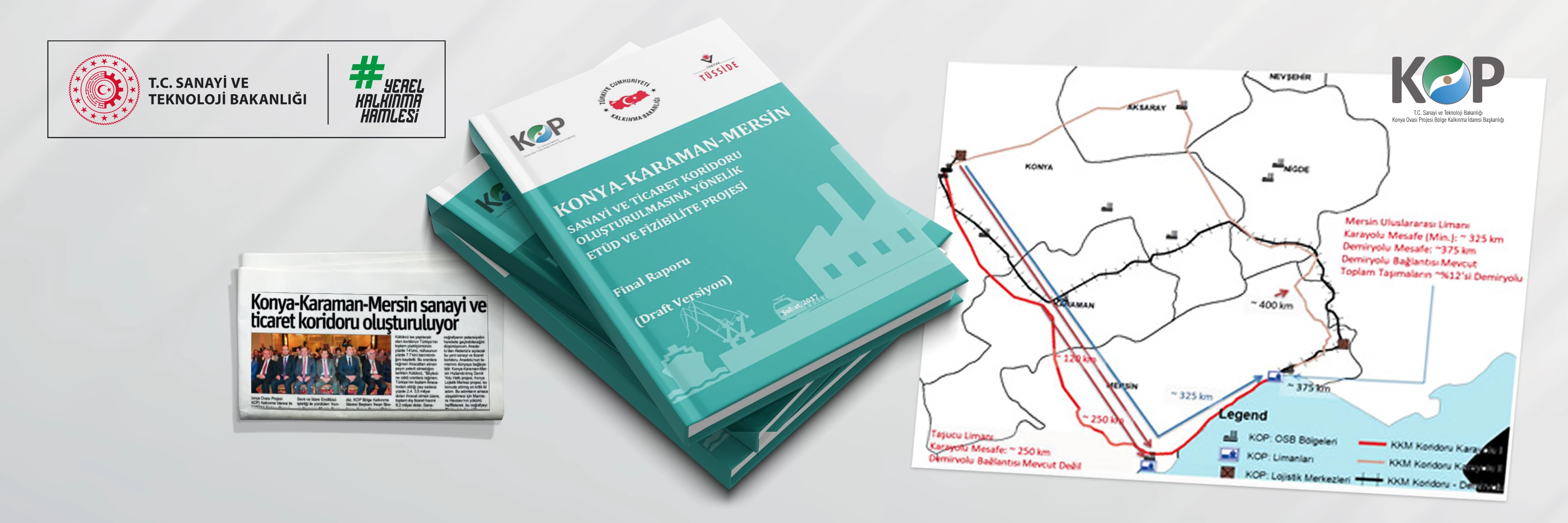
Konya-Karaman-Mersin Industry and Trade Corridor Study and Feasibility Project
In line with the emphasis in the Tenth Development Plan, the National Strategy for Regional Development, and the 2014–2018 KOP Action Plan—stating that “imbalances in the regional distribution of the manufacturing industry persist, industry and trade remain concentrated in the Marmara Region, and there is a need for new attraction centers”—the Konya-Karaman-Mersin Industry and Trade Corridor Study and Feasibility Project was implemented in cooperation between our Presidency and TÜBİTAK TÜSSİDE, with the aim of developing the naturally existing trade corridor between Konya and Karaman provinces and Mersin, one of Turkey’s leading trade and financial centers, and restructuring it to be more efficient.
This project is of great importance for strengthening the image of the Konya-Karaman Region as an investment location at national and international levels, improving the investment climate, and increasing the competitiveness of the region as a whole. Through this project, the components that will enhance the interaction of KOP Region provinces with nearby industrial, commercial, and financial centers were examined in a holistic manner, while a strategic roadmap to support sustainable development was drawn up, sub-investment needs to support the roadmap were identified, and the additional capacities to be created by such infrastructure were revealed.
Within the scope of the project: macroeconomic data of the region were summarized, and the current situation was analyzed; trend analyses related to the Konya-Karaman-Mersin Trade Corridor components were conducted, and port impact boundaries were defined; external market analyses of Turkey and the KOP Region were carried out. The region’s position in world trade, its economic impact boundaries, priority product groups, and sectors to be focused on were identified, and the potential positive economic impacts of Special Economic Zones (SEZs) targeting these specific groups (e.g., increased cargo volume, export growth, higher technological levels) were studied. The existing transportation network was modeled, and the connections of logistics centers such as Organized Industrial Zones (OIZs) and Small Industrial Sites (SISs) to ports were analyzed. Fieldwork was conducted with more than 500 experts through surveys and focus group meetings. On-site visits were carried out to logistics warehouses, organized industrial zones, ports, and freight loading centers, and the advantages and disadvantages of the region were evaluated with experts. In addition, assessments regarding incentive mechanisms were made, and methods that could trigger technological transformation were explored.
Recommendations for new management policies were developed within the framework of Special Economic Zones, such as single-office systems, cargo and procurement centralization, focus group benefits, and departmental centralization. The integration of SEZs with logistics centers was demonstrated. Furthermore, sample designs for required cargo consolidation centers were developed, and related findings and outputs were reflected in the report. The final report was shared with relevant institutions for feedback.
The project, contracted with TÜBİTAK Turkey Institute for Industrial Management (TÜSSİDE) for a total of 820,010 TL including VAT, was completed in April 2018.
Photo and Video Gallery
News about Project
Similar Projects

-webp.webp)